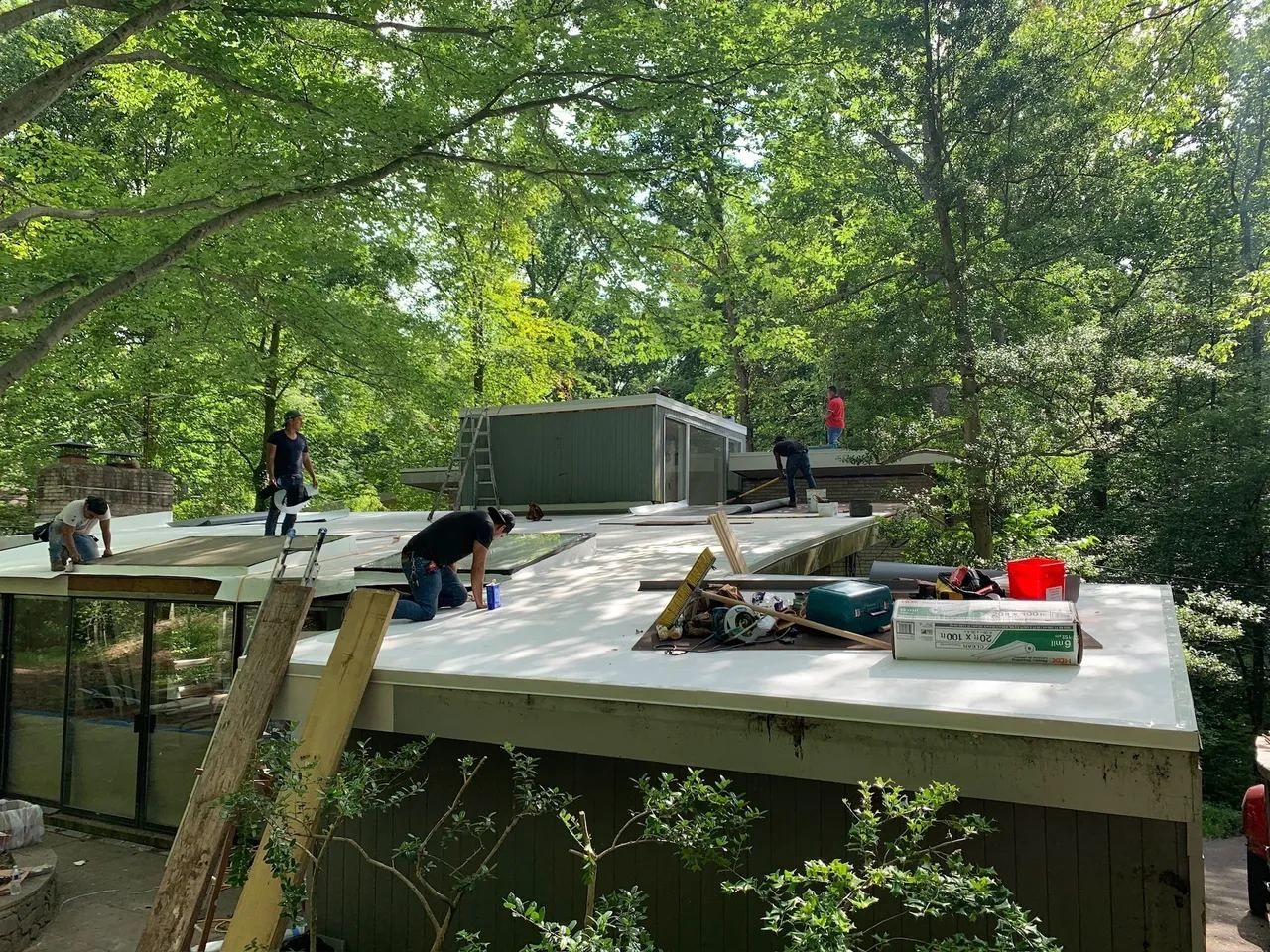
A commercial roof is not a big house roof. It is usually flat or close to it, it has drains, rooftop units and penetrations a house never has, and there is almost always somebody working downstairs while the crew is overhead: a shop that has to stay open, a congregation that meets on Sunday, tenants in the apartments above a corner store.
That last part shapes the whole project. Here is how a commercial roof job runs, start to finish, and what you should expect from your roofer at each stage.
The project at a glance
- First contact: what is going on, and what you already know about the roof.
- Site visit and roof survey: on the roof, under the roof, and photos of both.
- Repair, restore or replace: the decision, made on evidence.
- Choosing the roof system: TPO, EPDM, modified bitumen or metal.
- Written scope and fixed price: what will be done, and what could change it.
- Permits and approvals: the building permit, historic review, public space.
- Planning around the building’s users: schedule, access, noise, odors, deliveries.
- Tear-off and deck repairs: never more open than can be closed the same day.
- Installation: insulation, membrane, flashings, edges and drains.
- Final inspection and walk-through: the punch list, then cleanup.
- Closeout and maintenance: warranty, photos and a plan for the next 20 years.
1. First contact
The first call is short, but it goes faster if you have a few things ready:
- The address, what the building is used for and who occupies it.
- What is happening: an active leak, a roof near the end of its life, a sale, a lease renewal or an insurance claim.
- What you know about the roof: its age, the last work done on it, any warranty paperwork, and roughly how big it is.
- Photos, from inside and, if you can safely get them, from the roof.
- Who has access to the roof and when, and any deadlines you are working against.
If there is an active leak, say so first. The leak gets handled on its own track, and the bigger decision can wait until it is dry.
2. Site visit and roof survey
A real survey happens on the roof, not from the parking lot. The roofer should look at:
- The membrane: splits, blisters, open seams, brittleness and patches on patches.
- Drainage: drains, scuppers, gutters and downspouts, and where water stands after rain.
- The edges: parapet walls, coping, edge metal and the flashing where the roof turns up the walls.
- Everything that goes through the roof: rooftop units, curbs, vents, pipes, hatches and skylights.
- What is under it: often with a small test cut, to see how many layers are there and whether the insulation is wet.
- The inside: ceiling stains, the underside of the deck where it is visible, and any rust or rot.
You should get photos of what was found, not just a summary.
3. Repair, restore or replace
The survey decides which of three jobs this is.
- Repair when the problems are local, a failed seam, a flashing or a drain, and the rest of the roof is sound.
- Restore or recover in some cases, when there is a single existing roof, the insulation underneath is dry, and the deck is in good shape. Codes generally do not allow a new roof over two existing layers.
- Replace with a full tear-off when the roof is at the end of its life, the insulation is wet, or there are already two roofs on the building.
A good roofer will tell you when a repair is enough. If every visit ends in “you need a new roof,” get a second opinion. (We wrote more about this call in how to tell whether a roof needs a repair or a replacement.)
4. Choosing the roof system
Most low-slope commercial roofs in DC use one of these:
| System | What it is | Good to know |
|---|---|---|
| TPO | A white single-ply membrane, heat-welded at the seams | Reflective, common on new low-slope roofs, strong welded seams |
| EPDM | A black or white synthetic rubber membrane | Long track record, flexible in cold weather |
| Modified bitumen | Asphalt-based sheets in two or more plies | Tough and repair-friendly; common on older rowhouses and storefronts |
| Standing-seam metal | Metal panels with raised, locked seams | For roofs with some slope; long life, higher upfront cost |
The right choice depends on the roof’s slope and drainage, what is on it, how much foot traffic it gets, the budget and how long you plan to own the building. DC also has rules about reflective roofing on low-slope roofs, so ask how the system you are quoted meets them.
Insulation is part of the same decision. A tear-off is the cheapest moment you will ever have to add insulation, or to install tapered insulation that slopes water toward the drains on a roof that ponds.
5. Written scope and fixed price
The proposal is where most projects go right or wrong. It should spell out:
- The scope, itemised: what comes off, what goes on, and what stays.
- The system and manufacturer, membrane thickness, and the insulation and cover board.
- Flashings: new metal at the walls, curbs, pipes and edges, not reused old flashing.
- Drains and edges: what is replaced, rebuilt or cleaned.
- Deck repairs: how damaged deck is priced, and that you see it before it is replaced.
- What could move the price once the roof is opened, named up front.
- Permits, schedule, protection of the building and its contents, and cleanup.
- Warranty: what the manufacturer covers, what the contractor covers, and for how long.
- Payment schedule, and proof of insurance.
Ours are written that way: a fixed price, the scope itemised, and the things that could change it named before the work starts, not halfway through.
6. Permits and approvals
- Building permit. A commercial roof replacement in DC generally needs a building permit from the Department of Buildings. The contractor should pull it.
- Historic districts. If the building is in a historic district or is a landmark, visible changes go through the Historic Preservation Office. In-kind replacement of a flat roof is usually straightforward; changing a visible material is not.
- Public space. A dumpster, a lift or a crane on the street or sidewalk needs a public space permit, and it has to be booked in advance.
Permits and material lead times are why the weeks before the work often take longer than the work itself.
7. Planning around the people downstairs
This is the part that separates commercial roofing from residential. Before the first day on the roof, agree on:
- Working hours and noisy days. Tear-off is the loudest part; it can often be scheduled around your busiest hours.
- Access. Where materials go up, where the dumpster sits, and how customers, tenants and deliveries get in safely.
- Odors and air. Adhesives and torch-applied materials smell. Rooftop units and fresh-air intakes near the work may need to be shut down or shielded for part of the day.
- Protection inside. Under skylights, drains and known leaks, and around anything valuable.
- Weather. The crew should only open as much roof as it can close the same day, and someone should be watching the forecast every evening.
- One point of contact on each side, so questions get answered the same day.
Storefronts, churches and mixed-use corners are what we do, on buildings where somebody is working downstairs while we are on the roof, and this plan is how the business stays open while it happens.
8. Tear-off and deck repairs
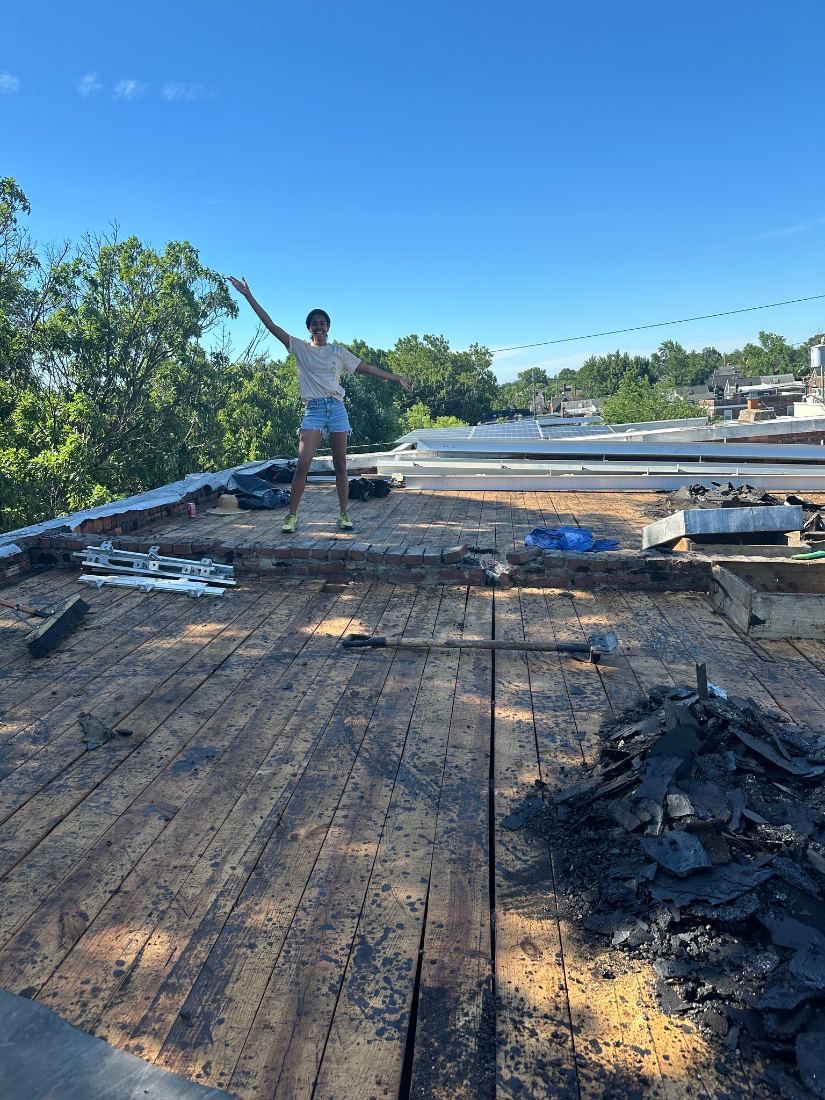
The old roof comes off in sections. Wet insulation is removed, and the deck is inspected once it is exposed. Soft or rusted deck is replaced, and nothing else: we replace only what is soft, and send you photos before we do. At the end of each day, the opened area is dried in so the building is watertight overnight.
9. Installation
The new roof goes on in layers:
- Insulation, tapered where the roof needs better drainage.
- Cover board, to protect the insulation and give the membrane a solid base.
- The membrane, adhered, fastened or welded according to the manufacturer’s specification.
- Flashings at every wall, curb, pipe and penetration. This is where most leaks start, so it is where most of the care goes.
- Edge metal and coping, to finish the perimeter and keep water out of the walls.
- Drains and scuppers, rebuilt or tied into the new roof.
- Walkway pads where people will walk to service equipment.
10. Final inspection and walk-through
Before the crew leaves, walk the roof with the contractor. Look at the flashings, the edges and the drains, and run water at the drains if it has not rained. Anything unfinished goes on a written punch list with a date. If the roof carries a manufacturer’s warranty, the manufacturer may send its own inspector before issuing it.
Cleanup should include the ground around the building, not just the roof, including a magnet sweep for nails and screws in parking areas and sidewalks.
11. Closeout and maintenance
When the job is done, you should have:
- The warranty documents, manufacturer and contractor.
- Photos of the work, especially of the deck and anything hidden under the new roof.
- The permit closeout.
- A short maintenance plan.
The usual advice in the roofing industry is to inspect a commercial roof twice a year, in spring and fall, and after major storms. Most of that is keeping drains and scuppers clear and checking the flashings. A roof that is looked at twice a year gets small repairs. A roof that nobody climbs onto until it leaks gets big ones.
How long does a commercial roof project take?
It depends on the size of the roof, the system, the number of layers coming off and the weather. A small storefront roof can be a few days of work on the roof itself. The steps before it, the survey, the proposal, the permits and the materials, usually take longer than the installation. Ask for a written schedule with the milestones on it.
Common questions
Can the business stay open during the roof replacement?
Usually, yes. With a plan for access, noise, odors and protection inside, most storefronts, offices and churches keep working while the roof is replaced.
Who handles the permits?
The roofing contractor should pull the building permit and any public space permits, and tell you before work starts if the building needs historic review.
TPO, EPDM or modified bitumen: which is best?
There is no single best; there is a best fit for the roof. Slope, drainage, foot traffic, rooftop equipment, budget and how long you will own the building all point toward one or another. A roofer who recommends the same system for every building is selling a product, not solving your roof.
How much does a commercial roof cost?
It depends on the size, the system, the number of layers coming off and how much of the deck needs work. We do not publish one number, because a price written before anyone has been on the roof is a guess. You get a fixed price in writing after we have seen it.
Have a commercial roof to look at? See our commercial roofing work, then send us the address and a few photos through the estimate form, or call (202) 495-1440. The estimate is free and written, and we are licensed for commercial low-slope work.